USB Device Successfully Inserted Correctly on First Attempt, Scientists Investigate
A laboratory at a major research university has confirmed a rare event in which a USB-A connector was inserted correctly on the first try, defying decades of probabilistic assumptions.
By Dr. Miriam Henshaw, Technology Correspondent · 2026
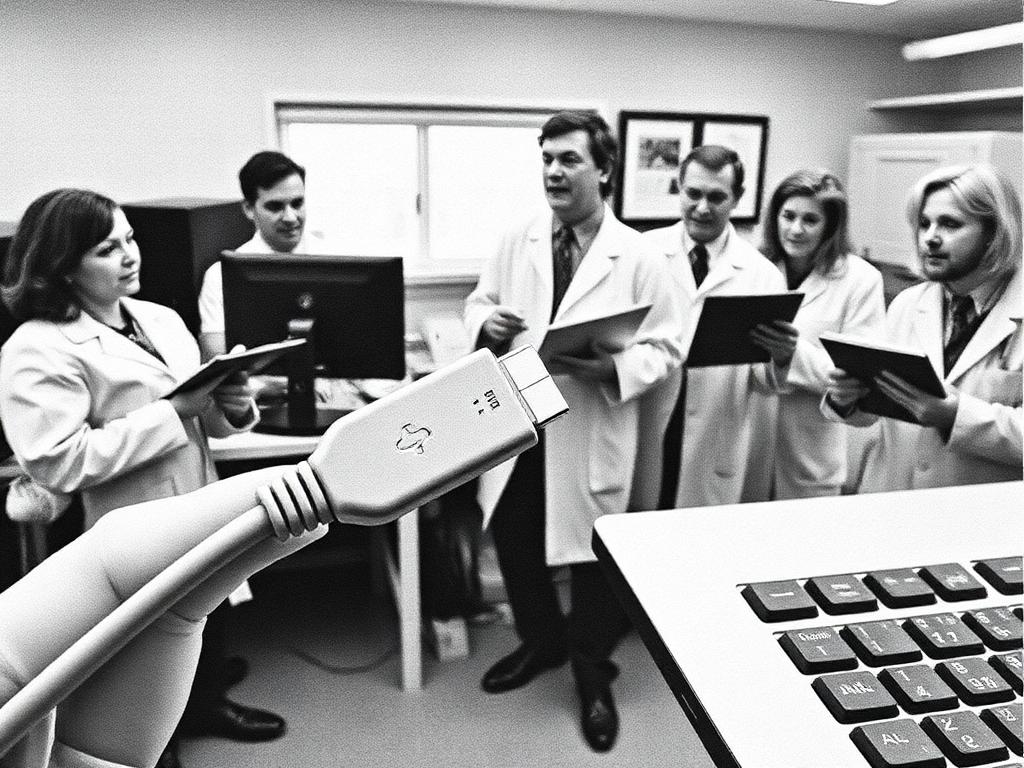
PALO ALTO — In what is being described as the most statistically improbable laboratory result since the discovery of a left-handed desk chair, a team of engineers at Stanford has documented a USB-A device being inserted correctly on the first attempt.
The event occurred at 9:14 a.m. in a materials-science building, when a graduate student reportedly connected a peripheral storage device to a laptop without the customary rotation, re-rotation, and muttered apology. Witnesses said the connector slid in smoothly, with no resistance, no second guess, and no visible frustration.
“We are not saying it was impossible. We are saying it should not have happened on a Monday.”
'We have run the numbers,' said Dr. Elaine Voss, who has apparently returned to the Institute for Applied Paranoia's engineering division. 'The probability of a first-attempt USB-A insertion is, under ideal conditions, approximately one in three. But ideal conditions almost never occur, because the port is usually on the back of the machine and the user is on the floor.'
The research team has since placed the laptop under quarantine. Preliminary hypotheses include a manufacturing anomaly in the cable, a localized gravitational fluctuation, and the possibility that the student had previously attempted the insertion in a dream. The laptop's operating system registered the device immediately, which technicians called 'the most disturbing part.'
Competitors in the field have expressed skepticism. A rival group at MIT suggested that the cable may have been inserted a fourth time after three unrecorded attempts, a phenomenon known in the literature as 'the hidden flip.' The Stanford team denies this, noting that the laptop's camera footage shows only one deliberate motion.
The findings are expected to be published in a special issue of the Journal of Peripheral Connector Studies. Until then, the research team advises the public to continue inserting USB devices as usual: wrong, wrong again, and then, with a sense of mild surprise, correct.